The Sorcerer’s Veil
A Luke Daniels Adventure
 Buy the Book:
Amazon
Apple Books
Barnes & Noble
IndieBound
Kobo
Libro.fm
Kindle
Nook
Synopsis
August 1941. Walt Disney and a team of animators travel to South America on a State Department-sponsored goodwill tour. While there Walt is given a gift. A 15th century Inca death mask named the Sorcerer’s Veil. Grateful, Walt brings the mask back home and keeps it safe until his death in 1966.
Present day. Luke Daniels is helping out his friend and co-worker, Marcia Pooler, with repairs on her farmhouse in rural Virginia. Their tranquility is suddenly shattered when armed assailants, led by a fierce revolutionary from Ecuador, appear and demand the mask. Things are further complicated when Sean Fernando, an old enemy bent on revenge, aligns himself with the Ecuadorians in their search.
Marcia’s grandfather, Gregg Pooler, was there in 1941 with Walt Disney in South America. After the war Gregg worked for Disney nearly fifty years. Before he died Walt gave Gregg the mask. The problem? Marcia knows nothing about its current whereabouts. But her grandfather left a way to find it, part of a Great Game they once played across Disney theme parks during her childhood. So Luke and Marcia embark on a journey―a hunt for an artifact that, as they learn along the way, holds the key to the future of Ecuador.
From the picturesque Virginia countryside, to the backstages of Disney’s world, and finally deep into the wilds of northern Ecuador, Luke and Marcia fight to stay ahead of their deadly pursuers, all while unlocking the secrets of the Sorcerer’s Veil.
Excerpt
PROLOGUE
Rio de Janeiro, Brazil
Tuesday – August 22, 1941 – 8:10 A.M.
WALTER ELIAS DISNEY WONDERED JUST WHAT HE’D MANAGED TO GET HIMSELF INTO.
He was an animator, innovator, head of a major movie studio. Not a diplomat. And certainly not a spy. Yet here he was, at the beginning of a ten week goodwill tour, organized by a newly formed government agency with the odd name of the Coordinator of Inter-American Affairs. The intent was to foster, as Nazi influence seeped into South America, harmony between the three Americas. Most of the attempts though had fallen flat, some going so poorly that they actually produced the opposite result. By the spring of 1941 South America had grown weary of U.S. ambassadors’ half-hearted attempts at garnering favor.
So Washington called him.
And not just anybody had been on the other end of the phone.
It had been Nelson Rockefeller himself.
“We need you to go and visit down there as part of our Good Neighbor Program. We’ve sent Douglas Fairbanks Jr., Dorothy Lamour, even the Yale Glee Club, to little or no effect. And it’s easy to see why. None of those compare to Walt Disney. They love you.”
“And how do you know that to be true?”
“I asked people down there who they would most like to meet. You were at the top of everyone’s list.”
Rockefeller had been the one to suggest to President Roosevelt that new ways were needed to improve inter-American relations. The political climate in Central and South America was deteriorating at an alarming rate. Roosevelt had agreed that there was a problem and appointed the wealthy New Yorker head of the CIAA. When first approached Walt had spurned the notion of a visit to the south. Cocktail parties, chit-chat, and handshaking were not his thing. But Rockefeller knew how to make a deal.
“Go see the people. Meet the children. Smile, be happy. Find inspiration for some future film projects, all at the United States government’s expense. It’s a win/win.”
“Where would I go?”
“Brazil, Argentina, Chile, Peru, and Ecuador.”
“Can I take who I like?’
“Of course. As many as you need.”
Which had sounded promising.
War raged across Europe and Asia. So far America had escaped involvement, but the conflict had shrunken his studio’s profits by over half. Even worse, a bitter animators’ strike cast a deep shadow over everything he’d built. His brother Roy was busy trying to settle that dispute. So why not go off in search of inspiration? Enjoy a wonderful interlude in a part of the world that had fascinated him for years.
And all on someone else’s dime.
So he’d handpicked a group of seventeen that included his wife, Lillian. They’d loaded up their art, photographic, and movie equipment, all the tools of their trade, and headed off on a grand adventure.
The Palace Hotel sat oceanside and faced the famed Copacabana beach and reminded Walt of some of the famous hotels on the French Riveria. Places where cosmopolitan wonder met old world glamour.
A lot like Hollywood.
Life had been good to him. He was only forty years old, in reasonably good physical shape, handsome, confident, the possessor of ten Academy Awards, more than any other person dead or alive. He’d been happily married for sixteen years with two wonderful daughters. True, he could be demanding and tough on subordinates. Sometimes unflinching and uncompromising. And a bit impetuous. Flaws for sure. But, overall, he was a shy, self-deprecating, somewhat insecure man. A natural poker player, someone once called him. He would simply say he was an ambivert, someone who could be outgoing when necessary. His main vices? He loved a stiff drink in the evenings and smoked incessantly all day.
But nobody was perfect.
Lillian had risen early and was already off to breakfast. He’d told her he’d be right down. But first he stepped over to the open French doors and lit another cigarette, gazing out past the terrace to the choppy blue waters of the Atlantic Ocean. The penthouse offered stunning views from seven floors up. Whatever Brazilian President Gabriel Almeida privately thought of the Americans’ visit the man had certainly rolled out the red carpet, commandeering the Copacabana’s top floor accommodations for Walt and Lillian. It had taken three days to fly from California to Miami, then another two days of flying south to Brazil. Nothing about air travel was easy and intercontinental communications were slow. Which meant they were on their own, making it up as they went.
Why had he agreed to this nonsense?
There were only two people in the world he truly trusted. His brother, Roy, and his wife, Lillian. Everybody else was suspect. Why was he like that? Easy. Too many rough roads, too many disappointments, too many betrayals. Both Roy and Lillian had encouraged him to come, saying he needed a break from all the demands of the studio. On that point he could not argue. The animator’s strike had cut him to the core. People he’d thought his dear friends turned out to be greedy, disloyal enemies. He was going to have a hard time working through those betrayals. That was why it was better for Roy to handle things without him.
A soft knock came to the suite’s main door, which opened and a younger man in his early-thirties, medium-height, with crinkly blue eyes and a trimmed mustache entered. They’d first met a month ago during the pre-planning for the trip. Gregg Pooler. Captain, United States Army, temporarily assigned to the State Department. Rockefeller had made clear that Pooler would be coming along under the guise of a Disney employee. The CIAA had not been subtle when they told him that Pooler was there both for your protection and our peace of mind.
Thankfully, he’d immediately liked Gregg.
“With three g’s.”
“That’s a bit odd of a spelling.”
“My father never wanted anyone to think it was short for Gregory, so he added the extra g.”
Okay. Seemed reasonable.
They’d had many conversations on the trip to Brazil. There was a no nonsense approach about the younger man that was hard not to like. Gregg made his way across the white marble-floor to the open doors where the humid tropical air hung like a damp blanket.
Walt half turned and smiled. “You a fan of the lower climes?”
“Born and raised in Baton Rouge, Mr. Disney. This feels like home.”
“What did I tell you on the plane? If you worked for me I’d dock you a dime every time you called me that. Walt will do just fine, please.”
“It’s kind of hard for me to do.”
“Give it a try. I think you’ll get the hang of it.” He pointed out to the ocean. “What do you see down there?”
Gregg stared out. “Guanabara Bay. The mountains flanking the entrance are Parrot’s Peak and Sugar Loaf. The two bigger islands are Fundão and Governador. Inland—”
“No, not the big ones, the archipelagoes.”
“Let’s see, there are roughly a hundred-thirty islands, mostly uninhabited but a few have post Colombian ruins, mostly forts and churches, all claimed by the Brazilian government. Easy to see why. Good military anchorages don’t come cheap and Brazil wants to be ready to entertain any and all suitors. So they need to control the bay.”
“That’s good. I too see opportunity down there.” He paused. “For someone. Let’s hope it’s not our enemy.”
He enjoyed the filterless cigarette down to the last quarter inch, then used it to light another. He dropped the used butt into an ashtray on the table just inside the door. “You have a knack for details, Gregg. Military training? Or natural inclination?”
“Mostly natural, I suppose.”
“That will never serve you wrong. I’ve been thinking. Take lots of pictures. That’s what they expect us to do, so no one will think a second about it. They could prove invaluable to our Washington benefactors, if you know what I mean.”
Nothing in life was ever free, and Walt had learned that this trip came with a cost. Two things had been made clear. First, they wanted him to note everything he saw, not only about the political and cultural climate of South America, but also about the locals and locales as well. And two, let no one become aware that he was noticing.
Since 1938 Nazi Germany had been extending its tentacles into Central and South America with alarming success. Already the governments of Brazil, Guatemala, and Uruguay were growing increasingly enamored of Hitler’s vision for Europe. Ecuador and Chile were both in upheaval. None of which the U.S. government could tolerate. Nazis weren’t interested in goodwill. They wanted military outposts in the western Atlantic. Newspapers predicted that the war in Europe would eventually envelope America. Having Kriegsmarine battleships and U-boats based in the western hemisphere would become an existential threat to the United States. Hitler had already invaded Czechoslovakia, Poland and France, and had signed a non-aggression pact with Russia. A month ago Italy had entered the war on Germany’s side, France had capitulated, Britain had been forced from the continent at Dunkirk, and the Luftwaffe had begun bombing London. Walt realized that there was no way America could stay neutral for much longer. So here he was, on a covert mission for the United States, to assess our southern neighbors.
A damn spy.
In the guise of an entertainer.
“But remember this,” he said to Gregg. “Always go beyond the details. Don’t get me wrong. They matter. But past the details is imagination, and that matters more.”
“That’s not my strong suit, I’m afraid.”
“Don’t be so sure. All those islands down there, how do they strike you?”
Gregg thought for a moment. “Downright piratesque, I guess.”
Walt glanced at him and smiled. “Exactly. Piratesque. Of course, that’s not a word, but it captures the essence. Makes one think of Blackbeard, Anne Boney, Captain Kidd. People love pirate stories.”
“Kids especially.”
“Oh, yes,” Walt murmured. “And parents love it when their kids are happy. How old are you, Gregg?”
“Thirty-two.”
“So young for such an important job.”
“I’m simply here as a—”
“Liaison, I know. You don’t mind all this, do you?”
“All what?”
“Playing my man Friday, as it were.”
“My pleasure. Mr. Dis—Walt.”
He finished his cigarette. “Have you seen any Nazis?”
“Two, I suspect, at the welcome dinner five nights ago. Special guests of President Almeida. I’m assuming that was a shot across the American bow.”
“You think he knows we’re here to spy on him?”
“He’d be a fool not to suspect.”
“How’d you spot the Nazis?”
“Their Portuguese had a Germanic tinge to it. And the way they carried themselves. There was a certain Prussian military bearing in it.”
“Quite observant. And, see, you clearly looked beyond the details.”
Gregg said, “I have a gift of languages. They come easy to me. I suspect it was one of the reasons I’m here.”
He stubbed out his cigarette. His fourth of the still-young day. “So what’s on our agenda?”
“A tour of the countryside and surrounding villages, a music festival at Morro da Urca, then a visit to the Corcovado. We end tonight with another dinner, this one at the Hotel Gloria with Brazil’s cultural elites. Artists, musicians, poets, that sort of thing.”
“And more Nazis?”
Gregg smiled. “Let’s hope so.”
“See if we can skip the music festival. I need more time in the villages. Rockefeller wants me to create some films and animation that reflect Latin culture, so that’s where we’ll find it.”
“I’ll see to it. You do know Argentina will be the worst. Germany has its claws in deep there. We will need to be extra vigilant.”
“I can handle that.” He returned his gaze to the ocean. “Pirates, eh?”
“Like the Spanish Main. The terrain is similar, as is the—”
“Piratesque milieu?”
“That’s it.”
“There is another matter,” Gregg said. “A man is waiting. Santo Concepión. You met him at the welcome dinner. He is the Ecuadorian ambassador to Brazil. He’d like to speak with you.”
“He say why he wants to see me?”
Gregg shook his head.
“Seems a bit early for an official visit.”
“And unannounced.”
“There is that too.” He considered the matter for a moment. Another trait he brought to the table on this multi-faceted trip was the ability to never rush to a decision. Take a moment. Think it through. Get it right. He had a few minutes before he had to head downstairs for breakfast with Lillian, and for that he could not be tardy. She hated eating alone. But—
“We’re here to listen and learn. Show the gentleman in and let’s do just that.”
Gregg walked back to the suite’s main door and opened it, revealing a man in his early-forties. Tall, lanky, wearing a white linen suit. Cradled against his chest was a small carved wooden box. Interesting that Gregg had made no mention of that. Seemed an important detail to omit.
The man entered the suite. “Please forgive the intrusion Señor Disney.”
Now he remembered meeting Concepión, spending several minutes with him at the welcome dinner, talking about Ecuador, which they would visit toward the end of the trip.
“It is good to see you,” Walt said. “You are out and about early.”
“I like the mornings. I get much done during the time.”
Walt nodded. “As do I. May I ask what is in that beautiful box?”
Concepión hesitated, then said, “An artifact. A cultural antiquity, I suppose you could call it. I thank you for seeing me. I am much a fan. I saw Snow White in Los Angeles two years ago. My daughter adores Mickey Mouse.”
Walt smiled, then shifted his voice to the nasal squeak of Mickey. “I do love my fans. Tell your daughter hello. We brought along some photos to autograph. Would she like one?”
Concepión beamed. “That is amazing.”
“I have been his voice from the beginning,” Walt said. “Mickey and I are quite close. But, please, do keep my secret.”
And he added a faux conspiratorial smile.
“Of course. Of course. My daughter will be thrilled. I thank you for the photo.”
Gregg disappeared for a moment and return with an 8 x 10 black and white image of Walt and Mickey. They’d brought along several hundred of them. Concepión carefully laid the box on a table and opened the lid, revealing a metal mask about the size of a small bread plate.
“That’s lovely,” Walt said. “May I?”
Concepión lifted the mask from its red velvet cradle and gingerly placed it in Walt’s outstretched palms.
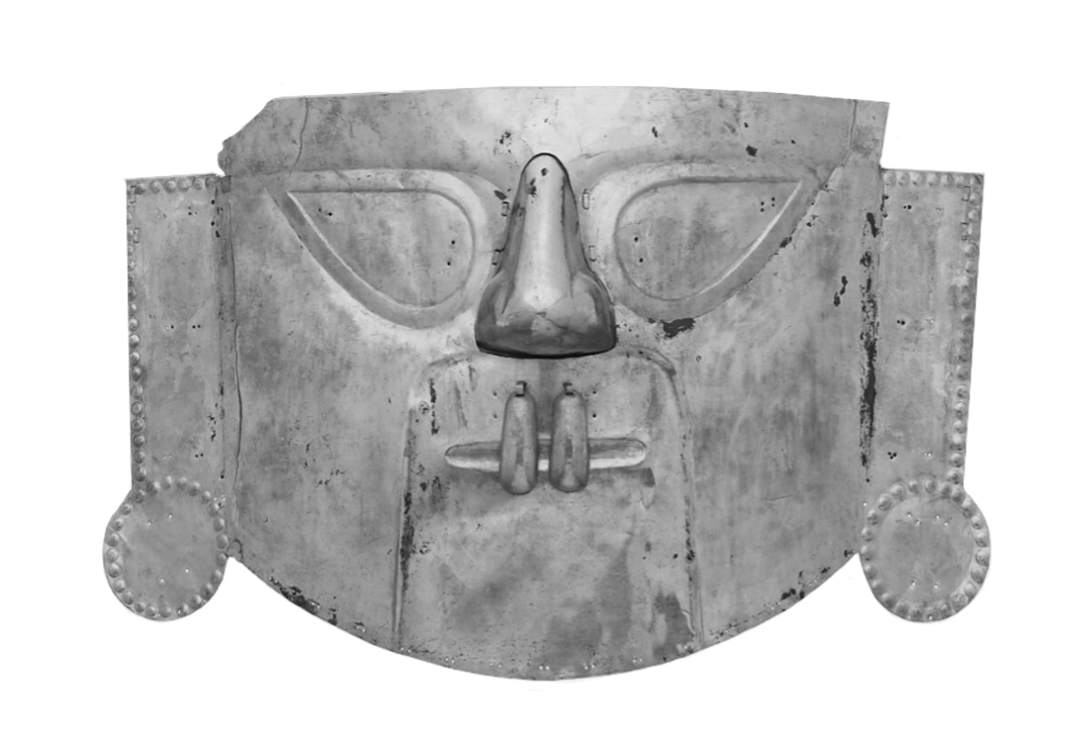
Walt said, “It’s so light. The metal so thin. An artifact, you say?”
“It belonged to my father.”
“Where was it found?”
“In northern Ecuador.”
Walt carefully turned the mask face down so he could inspect the inner concave surface. He noticed six rough markings etched into the metal. Two at the bottom, two at the top, one at each side.

And some writing scratched onto the surface.
El Miente.
“What do the words mean?” Walt asked.
“He lies,” Concepión said.
Walt smiled. “That is a might curious.”
The mask was a single piece of hammered metal. Silvery-gray. Untarnished. The front showed a face with large upturned eyes, thin mouth, and ornaments on the lips and ears. The nose was sculpted separately and attached with metal tabs. There were no perforations or openings that would have allowed anyone to see. But there were six tiny holes drilled through.
“How do use this mask?” Walt asked.
“It is only for the dead. Men of high status, like kings and priests. Inca lords were buried with them in caves and mounds, along with precious objects. As many as five masks were placed into each burial. One attached to the head of the wrapped body, the other four stacked at the feet.”
“And why was that done?” Walt asked.
“So the king would never be without a mask and always have protection from spirits in the afterlife.”
He nodded at the obviousness of the answer, then examined the artifact closer. Traces of red pigment could be seen along the edges of the cheeks and mouth. “Is that paint?”
“Cinnabar. This would once have been a deep crimson color. It is all hammered alloy. About forty percent gold, fifty percent silver, ten percent copper. The Inca were skilled in achieving a gold patina, removing the copper and silver from the surface through hammering and chemical enrichment. They were quite smart.”
“And skilled,” Walt said. “What are the six holes in the face? Do they serve a purpose?”
“I should say so, but that is a story for when you come to Ecuador.”
“And the etchings inside. The spiral symbol?”
His guest smiled. “More of that story when you come to Ecuador.”
“You’re going to keep me in suspense?”
“Is that not a storyteller’s job?”
He chuckled. “That it is. I tell my animators that all the time. I look forward to hearing that tale.”
“I can say this. My father told me the mask was found in the grave of a high priest. A great sorcerer, they say. So he named the mask the Sorcerer’s Veil.”
Walt said, “You do know I have some experience with a sorcerer. From my film Fantasia. There’s a sorcerer’s apprentice in that story.”
“I was unaware of that.”
“The film will be debuting here in Brazil, and in Argentina, during my visits. We brought it along with us.”
“How wonderful. I will take my daughter and we will come see it.”
Gregg asked, “Does your Ministry of Culture know about this artifact?”
“No, this is privately owned, which is allowed in Ecuador.”
Walt carefully returned the mask to the box. “Thank you for showing me this. Do you mind if we take some photographs? Gregg—”
“Oh, no, Señor Disney, you misunderstand. This is yours. I want you to take it back to America.”
He shook his head. “I can’t accept this.”
“But you must. Use it as inspiration for one of your films. Keep it close in your office or home.”
Walt’s eyes narrowed. “Why would you give this to me? It is a family heirloom. And you said yourself it’s special. One of a kind.”
“Is it not why you are here? To bring Latin culture back to America? To learn about us? It would be a great honor to my family for you to take this piece of our culture back with you. We ask only one thing. That you keep it safe and never part with it.”
Walt sighed and shook his head. “I still don’t feel comfortable doing that.”
“Please, señor, take it with you. You can return to America with anything you want, correct? No one will challenge Walt Disney. No one will know of this gift, but the three of us. I would like it kept that way.”
He could see this was important. So he had to ask, “Why the urgency, Señor Concepión?”
“As I am sure you know, things are changing. The world is in turmoil. My country is in turmoil. A bitter frontier war with Peru has erupted which is taking a toll in lives. Then there are the Germans, who are becoming more prevalent every day, exploiting our weaknesses. None of that change will be for the better. If you understand my meaning?”
Walt nodded. That he did comprehend.
“It is impossible to predict what will happen,” his visitor said. “This artifact is my family’s private property. I am the owner of it and I’m gifting it to you. And, I promise, if you do this I will tell you more about the mask when you come to Quito. It is quite interesting.”
He decided to stop arguing. It seemed pointless. And he’d not been sent here to refuse the locals. Just the opposite, in fact. So he thanked Concepión one last time, signed and personalized the photo, and the man left.
“That was unusual,” Gregg said, after closing the penthouse’s door.
Walt stared at the wooden box. “To say the least. He seemed a bit agitated.”
“I agree. What are you going to do?”
He’d been thinking on just that. “In the mid-west, where I grew up, there’s a saying. ‘Don’t look a gift horse in the mouth.’ Who knows, there might be a film in here somewhere. But we’ll honor his request and tell no one. Can you secret this box away with your stuff?”
Gregg nodded. “I can do that.”
A thousand people had greeted him five days ago when he arrived at the airport. The media had also turned out in full force. Quite a start to ten weeks of sketching, painting, filming, and photographing. Not to mention listening, learning, and asking questions. Señor Concepión had been right when he said they were there to garner an appreciation of other cultures.
And here was their first encounter.
He opened the lid and admired the mask one more time, blank eyes staring back at him.
“A mask that sheathed a high priest in death. A sorcerer. How amazing.”
“And its name?”
“Amazing too. Like something my animators would have thought of. The Sorcerer’s Veil.”
PRESENT DAY
CHAPTER 1
Fort Valley, Virginia
Wednesday – May 11 – 11:05 A.M.
LUKE DANIELS COULD NOT SHAKE THE FEELING OF BEING WATCHED.
That tingle at the back of his neck that told him to pay attention. Why was it there? Simple. Years of training as an Army Ranger, then a few more years as a Magellan Billet agent had sharpened his senses. Somebody was out there. Where? Impossible to know as all he saw were mountains and trees and all he heard were birds. Could it be just some hikers enjoying the wilderness?
Maybe. But it could also be much more.
He returned his attention to the roof below his feet and hammered the last loose shingle into place. It had taken over an hour to complete all of the patches, but now everything was once again waterproof.
He stood and used his high perch to gaze across the valley. Maybe in another life he would have been a geographer. Or a geologist. Places like this didn’t necessarily make him question his path as soldier-turned-Magellan Billet-agent, but it sure did make one think, as did the fact he’d never heard of this spot in the world until a week ago.
Fort Valley was known as the ‘valley within a valley,’ a tadpole-shaped groove in the earth twenty miles long and three miles wide nestled between the arms of the Blue Ridge Mountains. Aside from entrances at the north and south ends the valley was almost entirely enclosed by heavily-forested ridge lines, some up to two thousand feet, and otherwise largely inaccessible save for a few roads and some defined hiking paths. The lush earthen floor was split by a ribbon of water known as Passage Creek and dotted with knobs, hollows, and notches. The two story farmhouse upon which he was standing sat on ten acres at the eastern slope, a few miles from where the valley merged into Moreland Gap.
There were no proper towns nearby, just clusters of communities, farmsteads and ranches amounting to about 1200 people connected by State Route 678, a two-lane blacktop artery from which other gravel and dirt arteries sprung. It wasn’t quite The Land that Time Forgot, but Mother Nature had done her best to keep it isolated. He suspected the residents had either been born to it or, looking for seclusion, drawn to it. That was probably the case with the previous owner of the house below his feet, but he guessed that was a question best answered by the sledgehammer-wielding woman in the clearing below.
Despite her age, which she cagily described at ‘sixty thereabouts,’ Marcia Pooler was a dynamo, the half-demolished feed shack before her a testament to that fact. She handled a sledgehammer with the ferocity of a lumberjack. That’s what lap swimming six miles a week and daily spin classes did for you, she liked to say. That Marcia’s primary skill was as Magellan Billet’s cyber-ninja, a job that kept her behind a desk sixty-plus hours a week, made her physical stamina all the more impressive.
“Miss Marcia, how old is this place,” he called down to her.
She propped the sledge on her shoulder, used her palm to shade her eyes from the noon day sun, and gazed up at him. “You know, I’ve never been fond of that Miss Marcia stuff. Makes me feel old. How about just Marcia?”
“That’s gonna take some gettin’ used to.” It was a southern thing. Elders were always addressed as Miss or Mister followed by their first name. It had been ingrained in him from an early age, along with always adding ma’am and sir. But he said, “I’ll give it a try.”
“As to your question, the bones of the farmhouse you’re standing on are about 160 years old.”
He stared down at his boots. “That would have been good information to have before I mounted that ladder.”
“Would you have gotten up there if you’d known?”
“Fair point.”
“If it’s any consolation, that ladder’s only about a quarter as old as the roof. How’s the roof look?”
“Surprisingly good. Looks like Boppa got most of it done before he . . . y’know.”
“Crossed the finish line,” Marcia said. “That’s what he called it. Whenever I asked how he was doing, he’d answer ‘getting closer to the finish line.’ He got a chuckle out of that.”
“He was, what, a hundred?”
“Not quite. Ninety-eight. And it was Bumpa, not Boppa.”
“Yeah, what’s that about?”
“The story goes my sister’s first word was Grandpa, but she couldn’t quite get there so it came out Bumpa. Grandma got something similar. Gumma.”
“Bumpa Pooler,” Luke repeated. “It’s got a nice ring to it.”
“It’s all yours. Now get working on a wife so you can have grandkids you can talk into using it.”
“Don’t hurry me, woman.”
Marcia, as well as Luke’s mother and his grandmother, were in cahoots. No doubt about it. They wanted him married. His three brothers all were, with children. He wasn’t against the idea of settling down with the right woman, but working for the Magellan Billet, the Justice Department’s covert intelligence division, wasn’t exactly conducive to family life. As demanding and dangerous as Billet work was he had a hard time imagining adding the pressure of a family. His mentor-friend-slash-foil-Cotton Malone knew this fact too. Which explained more than anything else why Malone and Cassiopeia Vitt had not, as yet, tied the knot.
“Come on down,” Marcia called up. “I’ll make us some sandwiches with beers.”
Didn’t have to tell him twice. He was hungry. But he lingered a moment, watching the wilderness that surrounded him one last time.
Somebody was out there.
No doubt about it.
Watching.
Also in this series: